Ottawa Pothole Season 2026: Tire Damage & When To Call A Tow
⚠️ Quick Answer — Hit A Pothole In Ottawa?
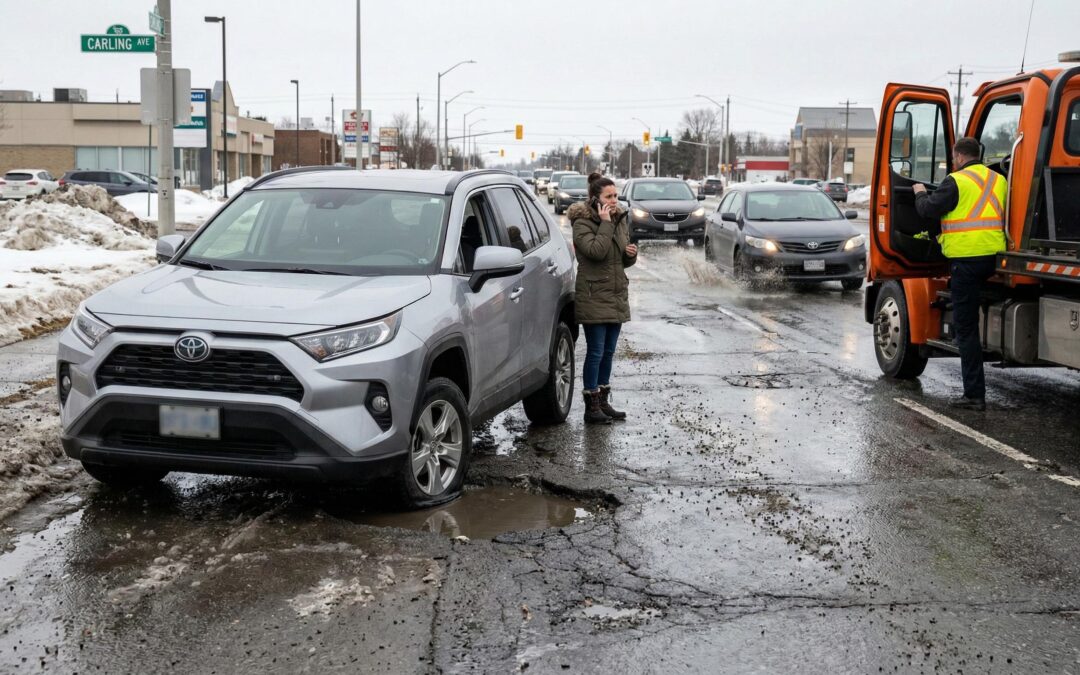
If your tire is flat, your steering pulls hard to one side, you hear grinding or scraping, or your vehicle is vibrating severely after hitting a pothole — do not keep driving. Pull over safely and assess the damage. A flat tire or visibly bent rim means you need either a spare tire change or a tow. Driving on a damaged tire risks a blowout, further rim damage, and suspension damage that turns a $200 repair into a $2,000 one.
🚛 Need help now? Call (613) 295-2264 for a tire change or tow — 24/7 across Ottawa.
Every spring, Ottawa’s roads transform into an obstacle course. The freeze-thaw cycle that runs from late February through April tears open the pavement, creating potholes that range from minor nuisances to full-on craters that can destroy a tire, bend a rim, crack a suspension component, or knock your alignment out of spec in a single impact.
The City of Ottawa typically fills over 200,000 potholes per year, but in peak pothole season there are always more holes than crews can reach. That means Ottawa drivers will inevitably hit one — and when you do, you need to know what kind of damage to look for, whether it is safe to keep driving, and when to call for a tire change or tow truck.
Why Ottawa’s Pothole Season Is One Of The Worst In Canada
Ottawa is not just cold — it is one of the most freeze-thaw-prone cities in Canada. That distinction is what makes our potholes so numerous, so deep, and so destructive.
🔄
Freeze-Thaw Cycles
Ottawa experiences roughly 40–60 freeze-thaw cycles per winter — days where the temperature crosses 0°C in both directions. Each cycle lets water seep into pavement cracks, freeze, expand, and break the road apart from the inside. More cycles means more potholes, earlier in the season.
🧂
Road Salt Accelerates Damage
Ottawa applies massive quantities of road salt each winter. Salt lowers the freezing point of water, which paradoxically increases freeze-thaw cycling within the pavement. It also chemically degrades the asphalt binder, making the road surface more susceptible to crumbling.
🚚
Heavy Traffic On Weakened Roads
Once the subsurface is compromised, the weight of traffic — especially buses and delivery trucks — punches through the weakened pavement layer. High-traffic corridors like Bank Street, Carling Avenue, and Bronson Avenue develop potholes faster and deeper than residential streets.
Types Of Damage A Pothole Can Cause To Your Vehicle
A pothole impact is essentially your wheel slamming into a sharp-edged concrete hole at speed. The damage can range from cosmetic to dangerous depending on the pothole depth, your speed, tire type, and wheel size. Here are the five most common types of pothole damage:
Flat Tire Or Tire Blowout
The most immediate and common result. The sharp edge of the pothole pinches the tire against the rim, puncturing the sidewall or causing an instant blowout. Sidewall punctures cannot be repaired — the tire must be replaced. This is different from a tread puncture (like a nail) which can often be patched. A flat tire from a pothole almost always means a new tire.
Bent Or Cracked Rim
Alloy rims are especially vulnerable. A hard pothole strike can bend the lip of the rim, crack the rim, or both. A bent rim causes a slow air leak and vibration at highway speeds. A cracked rim is a safety hazard — it can fail catastrophically at speed. Rim repair costs $100–$250 per wheel; replacement is $200–$800+ depending on the vehicle.
Wheel Alignment Knocked Out
A pothole impact can shift the alignment of the affected wheel — or all four. Symptoms include the vehicle pulling to one side, uneven tire wear, and the steering wheel being off-centre. Misalignment may not be obvious immediately but accelerates tire wear and affects handling. An alignment check costs $80–$120 in Ottawa.
Suspension Damage
The suspension absorbs most of a pothole impact. Severe hits can bend control arms, damage ball joints, crack struts or shocks, and break sway bar links. Suspension damage often presents as clunking noises over bumps, a bouncy or floaty ride, or the vehicle sitting unevenly. Repairs range from $200 for a link to $1,500+ for a full strut assembly.
Undercarriage & Exhaust Damage
Deep potholes — the kind that swallow half a wheel — can strike the undercarriage of low-clearance vehicles. This damages splash shields, heat shields, exhaust pipes, catalytic converters, and oil pans. A cracked oil pan is an emergency — if you see oil leaking after a pothole hit, stop driving and call for a breakdown tow immediately.
After Hitting A Pothole: Drive, Change Tire, Or Call A Tow?
This is the critical decision. Making the wrong call can turn minor pothole damage into a major repair bill — or put you in danger on the highway.
✅ Safe To Drive (Slowly) To A Shop
- Tires hold air and show no sidewall bulge
- No vibration or pulling at low speed
- No grinding, scraping, or clunking sounds
- Steering responds normally
- Action: Drive cautiously to a tire shop for inspection. Get alignment checked within a week.
🔧 Needs A Spare Tire Change
- Tire is flat or rapidly losing air
- Visible sidewall puncture or bulge
- Rim appears intact (no cracks or severe bends)
- You have a spare tire in the trunk
- Action: Change to spare and drive to shop, or call 613 Towing for a roadside tire change.
🚛 Needs A Tow — Do Not Drive
- Rim is visibly bent, cracked, or broken
- Multiple tires are flat or damaged
- Grinding or scraping sounds when moving
- Fluid leaking from under the vehicle
- Vehicle sits unevenly or suspension appears broken
- Action: Call (613) 295-2264 for a flatbed tow to your mechanic.
If you are stranded on a highway with a flat tire from a pothole, follow the safety guidelines in our flat tire safety guide. If the pothole caused a collision or your vehicle left the road, refer to our car accident Ottawa guide for the full step-by-step process.
What Pothole Damage Repairs Cost In Ottawa
Knowing the cost range for common pothole damage repairs helps you make informed decisions about insurance claims and whether a repair is worth pursuing through the City of Ottawa.
How To File A Pothole Damage Claim With The City Of Ottawa
If a pothole on a City of Ottawa road damaged your vehicle, you may be able to recover some or all of the repair costs through a property damage claim. The process is straightforward but requires documentation you should start collecting immediately after the incident.
Document the pothole and damage immediately. Take photos of the pothole showing its size and depth, your vehicle damage (tires, rims, undercarriage), your vehicle’s position relative to the pothole, and the street name or intersection. Include a reference object (water bottle, shoe) for scale.
Report the pothole to the City. Call 3-1-1 or use the ServiceOttawa 3-1-1 portal to report the pothole. This creates an official record that the City was notified — important for your claim.
Get a repair estimate from a mechanic. Have a licensed mechanic inspect and document all damage from the pothole impact. Get an itemized written estimate showing each damaged component and the repair cost.
Submit a property damage claim. File your claim through the City of Ottawa property damage claim form. Include your photos, the 3-1-1 reference number, the mechanic’s estimate, and a description of the incident. Claims must typically be filed within a reasonable time frame.
Wait for the City’s response. The City investigates whether they had prior notice of the pothole and whether repair timelines were met. Claims are assessed on a case-by-case basis. The process can take several weeks to months.
⚠️ Important: The City does not approve all claims. If the City can demonstrate they did not have prior notice of the pothole or that they repaired it within their maintenance standards, the claim may be denied. Filing through your auto insurance is an alternative — check whether your comprehensive coverage includes road hazard damage, though you may need to pay your deductible.
Ottawa’s Worst Roads For Potholes
While potholes can appear anywhere, some Ottawa corridors are consistently worse due to age, traffic volume, and subsurface conditions. Drive these roads with extra caution during pothole season:
🚧 Bank Street
Centretown to South Keys
🚧 Carling Avenue
Westboro to Lincoln Fields
🚧 Bronson Avenue
Glebe to Centretown
🚧 Montreal Road
Vanier to Orléans
🚧 Innes Road
Blackburn Hamlet to Orléans
🚧 Riverside Drive
Hog’s Back to Billings Bridge
🚧 Baseline Road
Algonquin to Greenbank
🚧 Hwy 417 On/Off Ramps
Transition zones across the city
613 Towing provides roadside assistance across all of Ottawa — including Kanata, Orléans, Nepean, and Downtown. If a pothole leaves you stranded on any of these roads, call (613) 295-2264 for a fast tire change or tow.
How To Protect Your Vehicle From Pothole Damage
You cannot always avoid potholes, but you can reduce the chance and severity of damage:
🛞 Maintain Proper Tire Pressure
Under-inflated tires have less cushion between the rim and the road, making rim damage more likely on impact. Over-inflated tires are stiffer and transmit more force to the suspension. Check pressure monthly — especially during spring temperature swings.
👀 Watch The Road Ahead
Scan 2–3 car lengths ahead for dark patches, puddles (which often hide deep potholes), and rough pavement. Increase following distance so you can see and react to road hazards. Night driving during pothole season is especially dangerous — potholes are nearly invisible.
🐌 Slow Down On Rough Roads
Impact force increases with speed. Hitting a pothole at 70 km/h causes dramatically more damage than hitting the same hole at 40 km/h. On roads known for potholes — especially the corridors listed above — reduce your speed during March through May. To protect yourself from towing scams in case you do need help, know your Ontario towing rights in advance.
🔧 Avoid Low-Profile Tires In Spring
Low-profile tires (common on sport and luxury vehicles) have less rubber between the rim and the road. They offer almost no cushion against pothole impacts and result in bent rims far more often than standard-profile tires. If your vehicle has low-profile summer tires, delay the switch from winter tires until the worst potholes are filled — typically late April or May in Ottawa.
Pothole Season Emergency Kit For Your Car
Keep these items in your trunk from March through May to handle pothole damage emergencies:
- Inflated spare tire & jack — check your spare’s pressure at the start of each season. Many spares sit flat for years and are useless when needed. If your vehicle only has a tire inflator kit (no spare), know that it cannot fix a sidewall puncture from a pothole.
- Tire pressure gauge — a $5 gauge helps you check whether a tire is losing air slowly after an impact.
- Flashlight — to inspect damage if you are stranded in the dark.
- Reflective triangles or vest — visibility is critical if you are pulled over on a road shoulder.
- Phone charger — you need your phone to call for help and document the pothole for your claim.
- 613 Towing’s number: (613) 295-2264 — saved in your contacts for a fast 24-hour tow or tire change if the spare cannot solve the problem.
Frequently Asked Questions About Pothole Damage In Ottawa
Can a pothole cause a flat tire?
Yes. Potholes are one of the leading causes of flat tires in Ottawa, particularly during March through May. The sharp edge of a pothole can puncture the tire sidewall or cause an instant blowout. Unlike tread punctures from nails, sidewall damage from potholes cannot be repaired — the tire must be replaced.
Should I keep driving after hitting a big pothole?
Pull over safely and inspect your tires, rims, and undercarriage. If tires hold air, there is no vibration, and steering feels normal, you can drive cautiously to a tire shop for a professional inspection. If you see a flat tire, bent rim, fluid leak, or hear grinding sounds, do not drive — call (613) 295-2264 for a tire change or tow.
Can I claim pothole damage from the City of Ottawa?
Yes. The City of Ottawa accepts property damage claims for pothole-related vehicle damage on City-maintained roads. You need to document the pothole with photos, report it through 3-1-1, get a mechanic’s repair estimate, and submit the claim through the City’s property damage claim form. Not all claims are approved — the City evaluates whether they had prior notice and met maintenance standards.
How much does pothole damage typically cost to repair?
Minor damage (single tire replacement + alignment) costs $230–$520. Moderate damage (tire + rim repair) runs $350–$700. Severe damage involving suspension components can reach $1,000–$2,500+. Adding a flatbed tow if the vehicle is undriveable adds $100–$225.
Does car insurance cover pothole damage?
Pothole damage is generally covered under your comprehensive or collision auto insurance, depending on your policy. However, you will need to pay your deductible, which may exceed the repair cost for minor damage. Check with your insurer — some policies specifically cover road hazard damage.
When is Ottawa’s pothole season?
Ottawa’s worst pothole period runs from late February through May, peaking in March and April when freeze-thaw cycles are most frequent. Potholes can appear year-round, but the spring thaw creates a surge of new and expanding holes across the city. By late May, most major potholes have been patched by City crews.
Can a pothole damage my suspension?
Absolutely. A hard pothole impact can bend control arms, damage ball joints, crack struts or shocks, and break sway bar links. Suspension damage often presents as clunking noises, a bouncy ride, or the vehicle sitting unevenly. If you notice any of these symptoms after hitting a pothole, have a mechanic inspect the suspension before driving at highway speeds.
How do I report a pothole in Ottawa?
Call 3-1-1 or use the ServiceOttawa 3-1-1 online portal. Provide the exact location (street, nearest intersection, lane), approximate size, and whether it is actively hazardous. The City prioritizes repairs based on size, location, and traffic volume. Reporting also creates a record for damage claims.
Can 613 Towing help if a pothole damaged my car?
Yes. If a pothole left you with a flat tire, 613 Towing can come to your location and swap to your spare tire. If the rim is damaged or the vehicle is not safe to drive, we can flatbed tow it to the mechanic or tire shop of your choice. Call (613) 295-2264 any time, 24/7.
Are low-profile tires more vulnerable to pothole damage?
Yes, significantly. Low-profile tires have thinner sidewalls that provide less cushion between the rim and the road surface. A pothole impact that a standard tire might absorb with a bulge will often crack or bend the rim on a low-profile setup. Consider delaying your switch to summer low-profile tires until the worst of pothole season has passed — typically late April in Ottawa.