Motorcycle Accident Ottawa: Towing & Recovery Steps 2026
🏍️ Motorcycle Down? Here’s What To Do:
1. If injured, do not move. Call 911 immediately.
2. If you can move safely, get yourself and the bike off the road.
3. Do not remove your helmet until you are sure you have no neck or spinal injury.
4. Call (613) 295-2264 for motorcycle towing — we use flatbed trucks with proper bike securing equipment.
Do NOT let a tow truck drag your motorcycle on a wheel-lift or hook — this causes frame and fork damage.
A motorcycle accident is a completely different situation than a car accident. There is no crumple zone, no airbags, and no steel cage around you. The rider is often injured. The bike is often on its side leaking fluids. And the towing process requires specialized knowledge — a motorcycle cannot be towed like a car. Using the wrong method will add frame damage, fork misalignment, and cosmetic scratches to whatever the accident already caused.
This guide covers everything Ottawa motorcyclists need to know about motorcycle towing after an accident: what to do at the scene, how professional tow operators secure and transport bikes, the costs involved, insurance considerations, and how to protect your ride throughout the recovery process.
How Motorcycles Are Properly Towed
A motorcycle must always be transported on a flatbed tow truck. There is no safe alternative. Here is what a professional motorcycle towing operation looks like:
1. Flatbed Only — No Exceptions
A motorcycle is loaded onto a flatbed truck with the bed tilted. The operator rolls or walks the bike up the ramp (if upright) or uses a winch if the bike cannot roll. Wheel-lift trucks, dollies, and tow bars are never used — they stress the frame and forks in ways they were not designed to handle. Learn why flatbed is always safest in our flatbed vs wheel-lift guide.
2. Wheel Chock Secures The Front
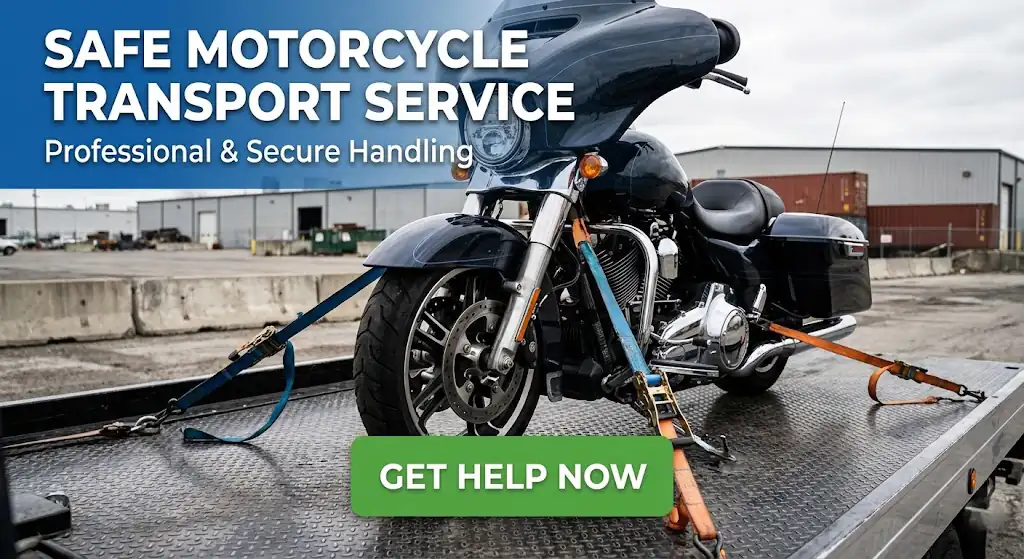
A wheel chock (a metal cradle bolted to the flatbed deck) holds the front tire in place and keeps the bike upright. Without a chock, the bike can lean, tip, or slide during transport. Professional motorcycle towing operators carry wheel chocks as standard equipment — if a tow truck shows up without one, that is a red flag.
3. Soft-Loop Tie-Down Straps
The bike is secured with ratchet straps using soft-loop attachments that wrap around the handlebars, triple tree, or frame — never directly around painted surfaces, chrome, or the forks. A properly secured motorcycle has four tie-down points creating downward pressure that compresses the suspension slightly, eliminating bounce during transport.
4. Damage-Free Loading
A professional operator loads a motorcycle with the same care you would give it yourself. No dragging, no bumping into the ramp edges, no metal-on-metal contact. After an accident, the bike may already be damaged — the tow process should not add to it. For more on preventing tow-related damage, see our towing damage guide.
🚨 Never allow these methods for motorcycle transport: Wheel-lift (front wheel raised, rear dragging), tow bar or A-frame, rope or chain attached to the frame, or any method that leaves one or both wheels on the road. These cause bent forks, frame stress fractures, transmission damage, and destroyed fairings. Insist on a flatbed with a wheel chock.
What To Do At The Scene Of A Motorcycle Accident
Assess Yourself First
Adrenaline masks injuries. Before moving, check for pain in your neck, back, and limbs. If anything feels wrong, stay still and wait for paramedics. Do not remove your helmet unless you are certain you have no head or neck injury — the helmet is stabilizing your cervical spine.
Get Off The Road
If you can move safely, get yourself out of traffic. If possible, move the motorcycle off the road too — but only if you can do so without risking further injury. A downed motorcycle in a live lane is a hazard to other drivers and to you.
Call 911 If Anyone Is Injured
Motorcycle accidents have a much higher injury rate than car collisions. If you or the other party is hurt, call 911 immediately. Even if you feel fine, get checked out — internal injuries and concussions often present delayed symptoms.
Document Everything
Photos of the scene, the bike, road conditions, the other vehicle (if involved), your injuries, and your damaged gear. Get the other driver’s insurance information, licence plate, and contact details. Witness names and numbers. This evidence is critical for your insurance claim. See our full accident guide for the complete documentation checklist.
Call For Motorcycle Towing
Call (613) 295-2264 and specify that it is a motorcycle. This ensures the dispatcher sends a flatbed with a wheel chock and soft-loop straps — not a standard car tow truck. Under Ontario’s TSSEA towing laws, you choose the tow company. Do not let an unsolicited truck at the scene take your bike.
Report The Collision
In Ontario, you must report any collision with damage over $2,000 or involving injury. For minor collisions (no injuries, over $2,000 damage), visit a Collision Reporting Centre. For serious accidents, police will attend the scene. Motorcycle damage often exceeds $2,000 even from seemingly minor incidents. The Ontario Motorcycle Handbook covers collision reporting requirements in detail.
Motorcycle Towing Costs In Ottawa
The motorcycle towing cost in Ottawa varies by distance and whether recovery is needed (e.g., pulling the bike out of a ditch vs picking it up from the road surface). Here is what to expect:
For a full breakdown of all towing costs including car towing, see our Ottawa towing cost guide. After an at-fault collision, motorcycle towing costs are typically covered by your collision insurance — keep the receipt.
Common Motorcycle Accident Locations In Ottawa
Ottawa has specific roads and conditions that are particularly hazardous for motorcyclists:
🛣️ Highway 417 (Queensway)
High-speed multi-vehicle environments are dangerous for bikes. Lane changes by cars that do not see the motorcycle are the top cause. The 417’s expansion construction zones through Kanata create uneven pavement, loose gravel, and narrow lanes that are treacherous for two wheels.
🏔️ Scenic Backroads (Old Chelsea, Gatineau Hills)
Popular weekend riding routes through the Gatineau Hills have tight curves, elevation changes, and gravel patches. Single-vehicle accidents (running wide on curves, gravel loss of traction) are common. These rural locations may have longer tow truck response times.
🚦 Urban Intersections
Left-turning vehicles are the number one cause of motorcycle accidents at intersections. Merivale and Baseline, Bank and Hunt Club, and the Baseline/Woodroffe area near Nepean are high-incident locations. Cars simply do not see the motorcycle.
🕳️ Pothole-Damaged Roads
Ottawa’s notorious pothole season is especially dangerous for motorcycles. A pothole that a car drives over with a bump can throw a motorcycle rider off or cause a flat at highway speed. Spring (April–May) is the most dangerous period — fresh potholes appear daily after the winter freeze-thaw cycle ends.
🛤️ Highway 174 East
The narrowing from freeway to two-lane highway east of Trim Road creates dangerous conditions for motorcycles — vehicles merge and close-pass in the transition zone. Read our Highway 174 breakdown guide for the full corridor analysis.
Protecting Your Bike & Gear After An Accident
📸 Photograph Before The Tow
Take photos of the motorcycle from every angle before it is moved — even if it is on its side. Document the position relative to the road, visible damage, fluid leaks, and the condition of fairings, tank, handlebars, and exhaust. These photos are essential for your insurance claim and protect you if additional damage occurs during transport.
🪖 Keep Your Damaged Gear
Do not throw away your helmet, jacket, gloves, or boots — even if they are destroyed. Damaged gear is evidence for your insurance claim and may be covered for replacement. A damaged helmet must be replaced regardless of visible damage (the internal foam absorbs impact energy and does not recover). Keep everything in a bag and photograph it.
⛽ Turn Off The Fuel (If Possible)
If the bike has a petcock (fuel shutoff valve), turn it to the off position before loading. Carbureted bikes (common on older models) can leak fuel when tilted during loading. Fuel-injected bikes are less prone to this but may still leak from damaged fuel lines or the tank. Alert the tow operator to any visible fuel leaks.
🔑 Remove Valuables
Take your keys, phone mount, GPS, tank bag, saddlebag contents, and any removable electronics before the bike is loaded. Storage yards and body shops cannot guarantee the security of accessories left on the bike. If you are injured and cannot do this yourself, ask someone you trust to retrieve them.
Motorcycle Accident Insurance In Ontario
Ontario’s insurance system treats motorcycle accidents slightly differently than car accidents. Here is what riders need to know:
📋 Ontario’s No-Fault System Applies
Like cars, your own insurer handles your motorcycle damage claim regardless of who caused the accident. Your collision coverage pays for the bike repair or replacement (minus deductible), and your insurer seeks subrogation from the at-fault party’s insurer. For details on how total loss settlements work, see our totalled vehicle guide.
🏍️ Motorcycle-Specific Coverage Gaps
Standard motorcycle policies may not cover aftermarket parts, custom paint, or performance modifications unless specifically declared. If you have invested in exhaust systems, suspension upgrades, or custom fairings, make sure they are listed on your policy with agreed values. Gear coverage (helmet, jacket, boots) varies by insurer — check your policy.
💵 Towing Reimbursement
Most Ontario motorcycle insurance policies include a towing benefit ($50–$200 per incident). Keep your towing receipt for reimbursement. If towing is not included in your policy, the cost is typically added to your collision claim. Ask your insurer before the tow if possible. For info on disputes, the FSRA handles Ontario auto insurance complaints.
Ottawa Riding Season: When Accidents Peak
April – May
Season start. Cold roads, sand/gravel residue, potholes, rusty riding skills. Highest single-vehicle crash rate.
June – Aug
Peak riding. Highest total accident count due to volume. Multi-vehicle collisions dominate.
September – Oct
Falling leaves + rain = slippery roads. Early darkness catches riders in low-visibility conditions.
Nov – March
Off-season. Bikes in storage. If yours needs towing to or from winter storage, call us for pickup/delivery.
Spring is the most dangerous period for Ottawa motorcyclists — cold road surfaces reduce tire grip, winter sand and gravel sit in curves, fresh potholes are everywhere, and riders are shaking off months of rust. Our 24-hour towing covers the full riding season and beyond. For winter-specific vehicle issues, see our winter battery guide — motorcycle batteries are even more vulnerable to cold-weather failure than car batteries. Riders considering a roadside assistance plan should verify it covers motorcycles specifically.
Frequently Asked Questions: Motorcycle Towing Ottawa
How much does motorcycle towing cost in Ottawa?
A local motorcycle tow within Ottawa costs $100–$200 for standard pickup and delivery. Accident recovery is $125–$350 depending on road or ditch extraction needed. There is no motorcycle surcharge — flatbed towing is flatbed towing regardless of whether it is a bike or a car.
Can a regular tow truck tow a motorcycle?
Only a flatbed tow truck should transport a motorcycle. Wheel-lift trucks, tow bars, and dollies are not suitable and will damage the bike’s frame, forks, and fairings. When you call (613) 295-2264, specify that you need motorcycle towing so the dispatcher sends the right truck with a wheel chock and soft-loop straps.
Will towing damage my motorcycle?
Not if done correctly. A professional operator using a flatbed with a wheel chock and soft-loop straps will transport your motorcycle without adding any damage. The risk comes from improper methods — dragging, tow bars, metal-on-metal contact, or straps attached to the wrong points. See our towing damage guide for full details.
What should I tell the dispatcher for a motorcycle accident?
Tell them: it is a motorcycle, the make and model, your exact location, whether the bike is upright or on its side, whether there are fluid leaks, and where you want it taken. Specifying “motorcycle” ensures they send a flatbed with proper securing equipment. For the full guide on what to tell a dispatcher, see our booking guide.
Does insurance cover motorcycle towing?
Most Ontario motorcycle insurance policies include a towing benefit of $50–$200 per incident. After a collision, towing is typically covered under your collision claim. Keep the itemized receipt from 613 Towing for reimbursement. Check your policy or call your insurer to confirm coverage limits.
Can you tow a motorcycle with no keys?
Yes. Keys are not needed for motorcycle towing — the flatbed operator loads the bike using a ramp and secures it with straps. The ignition does not need to be on. If you also need a new key, our locksmith service can handle many motorcycle makes. See our no-key towing guide.
Can you tow my motorcycle to a different city?
Yes. Our long distance towing transports motorcycles anywhere in Ontario and Quebec — Ottawa to Toronto, Montreal, Kingston, and beyond. Pricing is $2–$4 per kilometre on a flatbed with proper bike securing equipment.
Is motorcycle towing available 24/7?
Yes. 613 Towing’s 24-hour service covers motorcycles around the clock. Accidents do not wait for business hours — and neither do we. Call (613) 295-2264 any time, any day.
What if my motorcycle is totalled?
The insurance process is the same as for cars — the insurer determines if repair costs exceed the bike’s actual cash value (typically 70–80% threshold). Motorcycles are totalled more easily than cars because repair costs are high relative to value. If it is written off, we can handle scrap removal. See our total loss guide for the full process.
Can you move my bike to or from winter storage?
Yes. Many Ottawa riders store their motorcycles off-site during winter. We provide flatbed pickup and delivery to and from storage facilities, garages, or your home. Call (613) 295-2264 in late October or early April to schedule seasonal transport.