
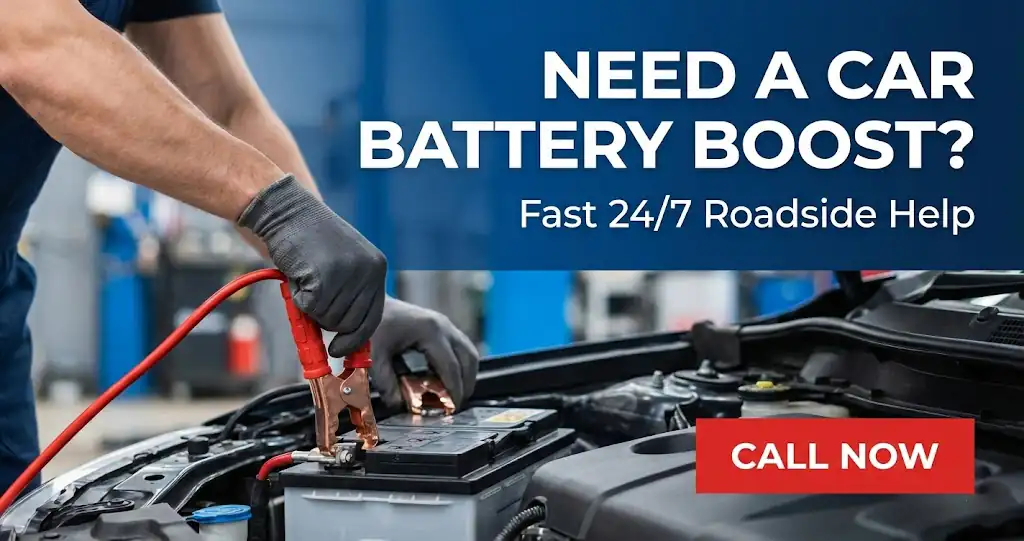
How To Jump Start A Car Battery: Step-By-Step Safety Guide (2026)
⚡ Quick Answer — Jump Start Cable Order
To jump start a car battery safely, connect jumper cables in this order:
- Red clamp → Dead battery positive (+) terminal
- Red clamp → Good battery positive (+) terminal
- Black clamp → Good battery negative (−) terminal
- Black clamp → Unpainted metal bolt on dead car (ground) — NOT the battery
Start the good car, wait 2–5 minutes, then start the dead car. Remove cables in reverse order.
A dead car battery is one of the most common reasons drivers get stranded. Whether it is a freezing winter morning, a scorching summer afternoon, or you accidentally left the headlights on overnight, knowing how to jump start a car battery is a skill every driver should have. A proper battery jump start takes about 5 minutes and can save you an expensive tow — but doing it wrong can damage your vehicle’s electrical system or even cause injury.
This guide covers the complete step-by-step process to safely jump start a dead car battery, common mistakes to avoid, what to do if the jump does not work, signs your battery needs replacement, and when to call a professional battery boost service instead. Whether you are in Ottawa or anywhere else in Canada, these steps apply to every standard 12-volt vehicle.
What You Need To Jump Start A Car
Before you attempt a jump start, make sure you have the right equipment. Here is what you need and why each item matters.
🔌 Jumper Cables (Booster Cables)
Get at least 4-gauge cables that are 6 metres (20 feet) long. Cheap thin cables restrict current flow and may not work on larger vehicles. Keep them in your trunk year-round.
🚗 A Second Vehicle (Or Portable Jump Pack)
You need a running vehicle with a good battery. Alternatively, a lithium portable jump starter can start most cars without a second vehicle — great for solo drivers.
🧤 Safety Gloves & Glasses
Car batteries contain sulfuric acid. In rare cases, a damaged or frozen battery can crack or release hydrogen gas. Gloves and eye protection are a smart precaution.
📖 Your Owner’s Manual
Some newer vehicles — especially hybrids, EVs, and some European models — have specific jump start procedures or designated ground points. Check the manual before connecting cables.
How To Jump Start A Car: Step-By-Step Instructions
Follow these steps carefully to jump start a car battery safely. The order of cable connections matters — getting it wrong can cause sparks, blow fuses, or damage the alternator.
Position Both Vehicles
Park the working car close to the dead car so the batteries are within cable reach — ideally nose-to-nose or side-by-side. Put both vehicles in Park (automatic) or Neutral (manual). Engage the parking brake on both. Turn off both engines, headlights, radio, and all accessories.
Identify The Battery Terminals
Open both hoods and locate the batteries. Each battery has two terminals: Positive (+) — usually marked with a red cap or “+” symbol — and Negative (−) — usually marked with a black cap or “−” symbol. If the terminals are corroded (white or green powder), brush them clean with a cloth before attaching cables.
Connect The Red (Positive) Cables First
Attach one red clamp to the positive (+) terminal of the dead battery. Then attach the other red clamp to the positive (+) terminal of the good battery. Make sure the clamps grip tightly and do not touch any other metal.
Connect The Black (Negative) Cables
Attach one black clamp to the negative (−) terminal of the good battery. Then attach the other black clamp to an unpainted metal surface on the dead car’s engine block — such as a bolt, bracket, or engine mount. Do NOT attach it to the dead battery’s negative terminal. This grounding technique prevents sparks near the battery where hydrogen gas may be present.
Start The Good Car
Start the engine of the working car and let it idle for 2–5 minutes. This allows the good battery’s alternator to push charge into the dead battery through the cables. In cold weather (below −15°C), you may need to wait 5–10 minutes for enough charge to transfer.
Start The Dead Car
Try starting the dead vehicle. If it starts, great — let both engines idle for another 2–3 minutes. If it does not start, wait 5 more minutes and try again. If it still does not start after 3 attempts, the battery may be too far gone or there is a different problem — see the troubleshooting section below.
Remove Cables In Reverse Order
Once the dead car is running, disconnect the cables in the exact reverse order: (1) Black clamp from the dead car’s ground, (2) Black clamp from the good battery, (3) Red clamp from the good battery, (4) Red clamp from the dead battery. Do not let any clamps touch each other or any metal while removing them.
✅ After The Jump Start: Drive the jumped vehicle for at least 20–30 minutes to allow the alternator to fully recharge the battery. Short trips or turning the car off immediately may leave the battery too weak to restart. If the battery dies again within 24 hours, it likely needs to be replaced.
Common Jump Start Mistakes That Can Damage Your Car
A battery jump start is straightforward when done correctly, but these common mistakes can cause serious damage to your vehicle’s electrical system, battery, or computer modules.
🚨 Safety Warning: If you see the battery is cracked, leaking, bulging, or frozen — do NOT attempt a jump start. A damaged battery can explode when current passes through it. Call a professional car battery boost service or have the vehicle towed instead.
Using A Portable Jump Starter (No Second Car Needed)
A portable lithium jump starter lets you jump start your car without another vehicle. These compact devices are roughly the size of a smartphone power bank and can deliver enough cranking amps to start most cars, trucks, and SUVs. Here is how to use one:
- Make sure the jump pack is charged — most need at least 50% charge to deliver enough power
- Connect the red clamp to the dead battery’s positive (+) terminal
- Connect the black clamp to an unpainted metal ground point (same as with cables)
- Turn on the jump starter — the indicator light should confirm it is ready
- Start your car — most vehicles will fire up on the first attempt
- Disconnect the clamps (black first, then red) and drive for 20+ minutes
💡 Buying Tip: Look for a portable jump starter with at least 800 peak amps for 4-cylinder engines and 1,500+ peak amps for 6- and 8-cylinder trucks and SUVs. Keep it charged and stored in your vehicle — not in the trunk during extreme cold, as lithium batteries lose capacity below −20°C.
Dead Battery? No Cables? No Problem.
613 Towing provides 24/7 battery boost service across Ottawa — we bring the equipment to you.
What To Do If The Jump Start Does Not Work
If the dead car does not start after 2–3 attempts with properly connected jumper cables, the problem may be deeper than a simple discharge. Here are the most likely causes:
🪫 Battery Is Completely Dead
If the battery has been dead for a long time or has deep-cycle damage, a jump may not provide enough charge. The battery needs to be replaced. Average cost for a new car battery in Canada is $150–$350 installed.
⚙️ Faulty Alternator
The alternator charges the battery while the engine runs. If it is failing, the battery drains even after a successful jump start. A mechanic can test alternator output with a multimeter.
🔧 Corroded Terminals
Heavy corrosion on battery terminals prevents proper electrical contact. Clean the terminals with a wire brush and baking soda solution, then try the jump again.
🚫 Starter Motor Failure
If you hear a clicking sound but the engine does not crank, the starter motor may be the issue — not the battery. This requires a tow to a mechanic shop for diagnosis.
If the jump start fails, your safest option is to call for professional help. Read our guide on choosing a reliable towing company in Ottawa. 613 Towing provides battery boost service with professional-grade equipment, and if the vehicle needs a tow to a shop, our breakdown towing service can transport it safely. For Ottawa-specific winter battery tips, read our guide on preventing dead car batteries in Ottawa winter.
Signs Your Car Battery Needs To Be Replaced
A battery boost is a quick fix, but if your battery is at the end of its life, a jump start will only delay the inevitable. Here are the signs it is time for a new battery:
- The battery is more than 4–5 years old — most car batteries in Canada last 3–5 years due to extreme temperature cycling
- Slow engine crank on startup — the engine turns over sluggishly instead of starting immediately
- Frequent need for jump starts — if you need a battery jump start more than once in a few weeks, the battery is failing
- Dim headlights at idle — headlights brighten when you rev the engine, indicating the battery cannot hold charge
- Battery warning light on dashboard — this can indicate the battery or the alternator needs attention
- Swollen or bloated battery case — caused by heat damage or overcharging, this is a safety hazard
- Electrical accessories malfunctioning — windows moving slowly, radio resetting, clock losing time
Can You Jump Start A Hybrid Or Electric Vehicle?
Yes — but with important differences. Hybrids and EVs have a small 12-volt auxiliary battery that powers the computer systems, locks, lights, and dashboard. This is the battery that can die and prevent the car from starting, and it can be jump started. However, you should never attempt to jump start the main high-voltage battery pack.
✅ Safe To Jump Start
- 12V auxiliary battery in hybrids
- 12V battery in EVs (Tesla, Leaf, Bolt)
- Use the designated jump points in your manual
🚫 Never Attempt
- Jumping the high-voltage battery pack
- Using a hybrid/EV to jump another car
- Connecting to orange high-voltage cables
Always check your owner’s manual for the specific jump start procedure for your hybrid or EV. The Canadian Automobile Association (CAA) also provides guidance on EV maintenance and roadside procedures. Some models — like certain Toyota Prius years — have the 12V battery in the trunk or under the rear seat, not under the hood. If you are unsure, call a professional. Our car battery boost service team has experience with all vehicle types including hybrids and EVs.
How Much Does A Battery Boost Service Cost?
If you do not have jumper cables, a portable jump starter, or a second vehicle, a professional battery boost service is your best option. Here is what it typically costs in Ottawa and across Canada.
In Ottawa, 613 Towing’s battery boost service is available 24/7 and typically arrives in 15–30 minutes. We cover Kanata, Orléans, Nepean, Downtown, and all surrounding areas. We test your battery after the boost to let you know if it needs replacement. For full pricing details, see our Ottawa towing cost guide. For step-by-step Ottawa-specific advice, check out our dedicated Ottawa battery boost guide.
How To Prevent A Dead Car Battery
Prevention is always cheaper than a battery jump start. These simple habits will help keep your car battery healthy year-round and save you from needing roadside assistance:
- Turn off all lights and accessories before exiting — interior lights, headlights, USB chargers, and dash cams drain batteries overnight
- Drive regularly — short trips and long periods of sitting drain batteries. A 20+ minute drive at least twice a week keeps the charge healthy
- Use a battery tender if your car sits for extended periods — a trickle charger maintains optimal charge without overcharging
- Keep terminals clean — corrosion increases resistance and reduces charging efficiency. A wire brush and petroleum jelly work well
- Test your battery before winter — most auto parts stores and mechanics offer free voltage testing. Replace it before the cold hits
- Replace your battery every 4–5 years — do not wait for it to fail. Proactive replacement avoids getting stranded
According to Transport Canada’s vehicle maintenance guidelines, regular battery testing is one of the most effective ways to prevent roadside breakdowns. For winter-specific battery care in Ottawa’s extreme climate, see our guide: how to prevent a dead car battery in Ottawa winter.
Frequently Asked Questions About Jump Starting A Car
What order do you connect jumper cables to jump start a car?
Connect in this order: (1) Red to dead positive, (2) Red to good positive, (3) Black to good negative, (4) Black to unpainted metal on dead car. Remove in the exact reverse order. Never connect the last black clamp directly to the dead battery.
How long does it take to jump start a car?
The entire process takes about 5 to 15 minutes. After connecting the cables, let the good car idle for 2 to 5 minutes before attempting to start the dead car. In very cold weather, you may need to wait up to 10 minutes.
Can you jump start a car in the rain?
Yes, it is safe to jump start a car in the rain. The 12-volt system in a car battery is low enough voltage that rain water does not pose a significant electrocution risk. Just make sure the cable clamps are securely attached and not sitting in standing water.
How long should I drive after a jump start?
Drive for at least 20 to 30 minutes after a successful jump start to allow the alternator to recharge the battery. Highway driving is more effective than stop-and-go city driving because the alternator produces more current at higher RPMs.
Can jump starting a car damage the electrical system?
If done correctly, no. However, reversing the polarity (connecting positive to negative) can blow fuses, damage the alternator, and fry the engine control unit. Always double-check your connections before starting either vehicle.
Why does the last black clamp go on metal instead of the battery?
Car batteries produce small amounts of hydrogen gas, especially when discharged. Connecting the last clamp to the battery terminal can create a spark that ignites this gas. Grounding to engine metal moves any spark away from the battery.
Can a completely dead battery be jump started?
It depends. If the battery is simply discharged (drained by lights or accessories), a jump start will work. If the battery has internal damage, is frozen, or has been dead for weeks, a jump may not work and the battery will need to be replaced.
How much does a professional battery jump start cost?
A professional battery boost service typically costs $59 to $129 depending on the provider, time of day, and location. In Ottawa, 613 Towing provides battery boost service 24/7 starting from $59. Call (613) 295-2264 for an exact quote.
Can I use a hybrid or electric car to jump start another vehicle?
It is generally not recommended. Most hybrid and EV manufacturers advise against using their vehicles to jump start other cars because the current draw can damage the hybrid’s sensitive electrical system. Use a dedicated portable jump starter instead.
Does CAA or insurance cover a battery jump start?
CAA memberships in Canada include battery boost as part of roadside assistance, though wait times can be long during peak periods. Standard auto insurance does not cover jump starts unless you have the OPCF 35 roadside endorsement. Some credit cards and dealership warranties also include roadside assistance.